Jeff Brown's blog

Jeff Brown's blog: All posts

Statement by President Jacob Zuma on the appointment of the new Cabinet 10 May 2009http://www.info.gov.za/speeches/2009/09051016451001.htmMembers of the media,   Good afternoon and thank you for joining us.   We have since the launch of the ANC Manifesto indicated the type of new administration we envisaged in terms of size, shape and political focus.  We wanted a structure that would enable us to achieve visible and tangible socio-economic development within the next five years. It should be a structure which would enable us to effectively implement our policies.  The structure of Cabinet and national departments has therefore been re-organised to achieve better alignment between the structure, our electoral mandate as per our election Manifesto, and the developmental challenges that need to receive immediate attention from government.

Wild Ocean is in an uplifting, giant screen cinema experience capturing one of nature's greatest migration spectacles. Plunge into an underwater feeding frenzy, amidst the dolphins, sharks, whales, gannets, seals and billions of fish. Filmed off the Wild Coast of South Africa, Wild Ocean is a timely documentary that celebrates the animals that now depend on us to survive and the efforts by the local people to protect this invaluable ecological resource. Hope is alive on the Wild Coast, where Africa meets the sea.

Check out the film's trailer on the official website at www.wildoceanfilm.com

Wild Ocean has been Selected as 2009 Earthwatch Film of the Year

Wild Ocean 3D highlights one of nature’s greatest migration spectacles, plunging viewers into an underwater feeding frenzy, an epic struggle for survival where whales, sharks, dolphins, seals, gannets and billions of fish collide with the most voracious sea predator, mankind.

Filmed off the Wild Coast of South Africa and set to the rhythm of the local people, Wild Ocean 3D reveals the economic and cultural impact of the ocean while celebrating the communal efforts to protect our invaluable marine resources.

The film chronicles a massive annual feeding frenzy; billions of sardines travel up the Wild Coast and to the coast of Kwa-Zulu Natal. For the people living along the African shore, this migration has provided a food source for countless generations while farther out at sea ocean predators come from great distances to feast.

Bottlenose dolphins create superpods, thousands strong, to track down the huge shoals using sonar. Sharks sense blood in the water and join the hunt. Seals and common dolphins chase the fish from cooler currents up the coast into the warmer tropical waters. Diving birds, Cape Gannets, join the battle with aerial attacks from the sky.

All of these animals are drawn to the scene, enmeshed in one of the most incredible mass feeding melees in the natural world.

Unfortunately, such a richness of life is now rare in our seas. For centuries the ocean was considered a vast limitless resource. As fishing practices grew more industrialized and efficient throughout the 20th century, entire fish stocks around North America, Europe, and Asia began to collapse.

The fish, hauled onto boats by the ton, were an integral part of a complex marine ecosystem, a link in a great food chain on which many predators depend.

Eventually, entire fish species were decimated and the ocean predator populations went into a steep decline. Now a new threat, global climate change, threatens to further damage the fragile ocean ecology.

While Wild Ocean 3D explores the causes and effects of man’s impact, it is an inspirational film looking toward a bright future, taking audiences to a rare unspoiled marine wilderness to glimpse what the oceans of the world once looked like. The film champions the creation of marine reserves necessary to bring our oceans back to life. South Africa leads the way. It is a film about the people that come together to protect our world. Hope is alive on the Wild Coast, where Africa meets the sea.

August 2008 a vaccine against Biliary of dogs was introduced in South Africa.

More info here: http://www.proteaanimalclinic.co.za/bosluisenteng.htm

The vaccine is not to be used in animals younger than six months or in pregnant bitches. Sick animals or dogs with lots of ticks should also not be vaccinated. At least two weeks must be allowed for between this vaccine and other vaccines such as the Distemper/Parvo combinations.

The first vaccination is followed a month later by a booster and then twice yearly booster vaccinations are recommended at present.

"Fish" has had biliary 3 times in the past year and a half, so this vaccination is definitely recommended to anyone coming to the Wild Coast with their pet. Especially in summer when there are so many ticks around.

## Free Software Foundation Files Suit Against Cisco For GPL Violations
The case is number 08-CV-10764 and will be heard by Judge Paul
G. Gardephe. A copy of the complaint is available at
.

### About the FSF

The Free Software Foundation, founded in 1985, is dedicated to
promoting computer users' right to use, study, copy, modify, and
redistribute computer programs. The FSF promotes the development and
use of free (as in freedom) software -- particularly the GNU operating
system and its GNU/Linux variants -- and free documentation for free
software. The FSF also helps to spread awareness of the ethical and
political issues of freedom in the use of software, and its Web sites,
located at fsf.org and gnu.org, are an important source of information
about GNU/Linux. Donations to support the FSF's work can be made at
. Its headquarters are in Boston, MA, USA.

Some of you might be aware of reports about possible illegal fishing vessel activity along the Wild Coast over the last few years. As the authorities seem to happily take the stance that 'if we don't see it then it ain't happening' Val Payn from SWC (www.swc.org.za) thought it might be useful if members of the public could help to become 'eyes and ears' to try and gauge the extent of the problem.

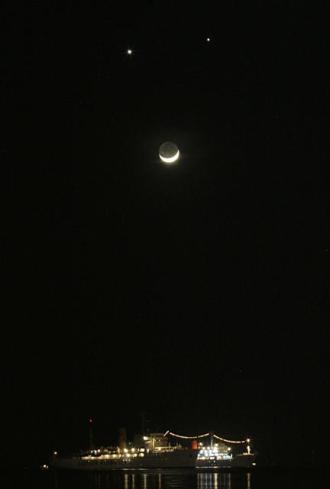
A rare positioning of planets Venus, top left, and Jupiter, top right, and the crescent moon of the Earth provides a "smiley" effect as seen from Manila, Philippines, Monday night, Dec. 1, 2008. (AP Photo/Aaron Favila)

(http://channels.isp.netscape.com/whatsnew/gallery.jsp?gname=wnew_moon_ve...)

And one from East London, South Africa, by Shane Parkins:

http://www.miningmx.com/grnbk08/895040.htm

MINING COMPANIES OPERATING in South Africa face a barrage of changes to their legislative environment.

From the Mining Charter to royalties, to health and safety and including environmental laws and a deeply controversial Expropriation Bill, companies are going to have to be on their toes in an environment already regarded with a great deal of suspicion by investors overseas.

The perception of SA and its mineral policies leaves it at the bottom end of a list of 68 mining countries surveyed by the Canadian-based Fraser Institute despite soothing assurances by officials from our Department of Minerals & Energy (DME) claiming its new legislation enacted in 2004 has liberalised the industry and introduced new players.

The institute says its survey acts as a “report card to governments on how attractive their policies are from the point of view of an exploration manager”.

Ferry Point in Port St Johns is pleased to announce the availability of daily horse riding on Long Beach, between Ferry Point and Poenskop.

Their horses are sound and well schooled; so whether you are an experienced rider or absolute beginner, you will enjoy the spectacular beaches, fabulous mountain views and peaceful forests.

Come and enjoy some time on the Wild Coast and help our kids with computer literacy, eco-schools (environment) projects, sport and other extra-curricular activities.

The program addresses the needs of two increasingly important developmental areas of the Eastern Cape in South Africa: Education and the Environment. The focal area of VA32° south is the Transkei Wild Coast. Under the apartheid government from the1950’s – 1994, the Transkei and other Bantustan "homelands" remained deliberately underdeveloped regions from which the dominant white economic sector could draw on a consistent labor pool who were largely denied access to equal opportunities within society, and were therefore unable to challenge the monopoly at an academic and economic level. The region today remains for the most part an undeveloped, rural enclave within South Africa. Access to effective education, resources and equal opportunities are leading challenges facing the communities of the Wild Coast. YOU CAN REALLY MAKE A DIFFERENCE! http://www.volunteerafrica.co.za/

Looking around for images to include in the schools network proposal I'm giving at the Rotary club in Umtata tomorrow, I came across a few logo designs I made for the Gauteng Linux Users Group in 2004.

The general consensus was that they were too retro. Ah well, I still kinda like 'em. : )

Here're some of them:

I thought that the iconic G could work for various things, like:
.
..
...
....
.....

I came up with something else, quite lame, that I never showed anyone:

.
.
And a combo:

And the alternative I came up with was also too embarrassing to show anyone because the perspective was fscked, and by then I was bored:

They still don't have a logo though... www.glug.org.za

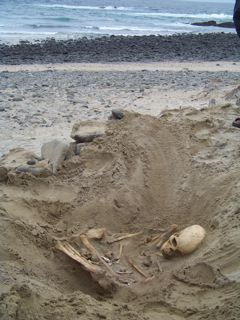
A skeleton (apparently that of a slightly built woman by my first impression - which was corroborated by M.R. who is also a slightly built woman; and she noted and compared the size of the pelvis and femur) was discovered in a shallow grave on Mens Beach at Hole in the Wall on Saturday.

The body could not have been buried very long ago, due to the fact that it was right behind the stonewall barrier that was only built a few years ago.

I received 2 XO laptops for development purposes on Friday. What an amazing marvel of technology and Open Source philosophy! Huge respect to the visionaries responsible for this wonderful educational tool (Nicholas Negroponte, Mary Lou Jepsen, Walter Bender, and many others). Actually it looks like a Fisher Price toy, but it's really a full featured Linux based computer.

We were treated to a glimpse of the royal brothers as they overnighted at the Hole in the Wall hotel yesterday. They are currently on a charity motorcycle ride from Port Edward to Port Elizabeth (good colonial names those, hehe), along with about 120 other riders.

I was warned to ask permission before taking any photos; so I approached their table hesitantly but was politely and diplomatically declined. Ah well. Not that I'm much of a royalist anyway, but I certainly wouldn't want to impose.

Later we went to Coffee Bay and bumped into a good friend at the Ocean View Hotel, who was busy showing a table of British paparazzi some photos of William as he was refueling at the petrol station. She also got the back of Harry, as he had seen her camera, and he gave her a cheeky grin as he quickly turned his back and slipped his helmet on. Several people have offered her real money for the photos.

The weather today is fine and clear, but there's a roaring North Westerly blowing. Their destination is unknown, but is believed to be Mazeppa Bay according to the sagoodnews website: http://www.sagoodnews.co.za/general/princes_william_and_harry_to_ride_th...

Since the site also maintained that they would be overnighting at Coffee Bay and not Hole in the Wall, it's anyone's guess where they will actually end up.

The almost entirely off-road motorcycle ride will raise money for UNICEF, the Nelson Mandela Children's Fund and Sentebale, founded in 2006 by Prince Harry and Lesotho's Prince Seeiso, for projects in South Africa and Lesotho.

"Even today the coast where the Grosvenor was lost is a space of great emptiness and profound silences. Its boundaries are difficult to define because it is as much an area of consciousness as it is a geographic location. To start with, though, it can be reached by driving south-west from the South African port city of Durban for about 90 miles to the little seaside town of Port Edward. From there one proceeds on foot - a few miles to the Umtamvuna River, then across it to where a band of unbroken beach begins and stretches for miles ahead into a hazy mist of pale blue It is here where the emptiness begins and where one can mark the beginning of the Wild Coast."

The Caliban Shore - The Fate of the Grosvenor Castaways - by Stephen Taylor (p.94)

This book is well worth buying and treasuring.

Here are some reviews and links to purchase online:

http://www.guardian.co.uk/books/2004/feb/22/historybooks.features

The Mzamba/Xolobeni area is located closer to the Continental Shelf than any other part of South Africa, and, interestingly enough, there is a cretaceous deposit and "petrified forest" at the mouth of the Mzamba river. Also interesting, although possibly unconnected, is the fact that the Pondoland Center of Endemism (PCE) seems to fall exactly adjacent to the "trench" where the Continental Shelf is closest to the actual African continent.

In order to sail the South Atlantic and round the tip of Africa, Portuguese sailors had to confront two powerful ocean flows: the Agulhas and Benguela currents.

The warm Agulhas runs south and west from the Indian Ocean pushing against the near-freezing waters of Antarctica, before meeting the cold Benguela current off the Cape of Good Hope.

The second swiftest current in all the world's oceans, the Agulhas is deadlier than the swiftest current (the Gulf Stream) for two reasons. First one of its branches surges through a narrow passageway between Madagascar and Mozambique on the east coast of South Africa (downward arrow on map). Furthermore its waters rush from north to south--the opposite direction from which Portuguese ships needed to travel in order to round the tip of Africa.

Discovery of the Coincidence of Magnetic and True North

Rounding the southern coast of Africa in the 1480s and 1490s, Portuguese navigators discovered one point where magnetic north and true north were virtually identical. They called this place the "Cape of the Needles" (Cabo das Agulhas) because all compass needles pointed to true north.

On this 1516 map, Cape Agulhas is clearly marked with the compass needle pointing due north.

As you can see from the map, Portuguese sailors knew this so well that they had it on all their maps!

Digital technology has made it easy to create new works from existing art, but copyright law has yet to catch up.

http://online.wsj.com/article/SB122367645363324303.html

By LAWRENCE LESSIG

In early February 2007, Stephanie Lenz's 13-month-old son started dancing. Pushing a walker across her kitchen floor, Holden Lenz started moving to the distinctive beat of a song by Prince, "Let's Go Crazy." He had heard the song before. The beat had obviously stuck. So when Holden heard the song again, he did what any sensible 13-month-old would do -- he accepted Prince's invitation and went "crazy" to the beat. Holden's mom grabbed her camcorder and, for 29 seconds, captured the priceless image of Holden dancing, with the barely discernible Prince playing on a CD player somewhere in the background.

Valerie Sinclair

How it's done.

Did you know?

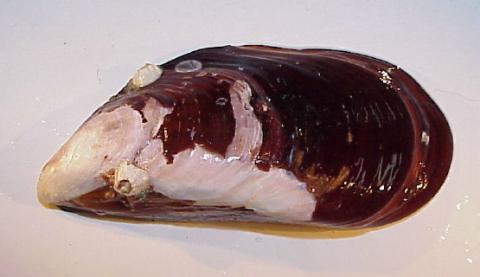
Although some mussels can live for up to 50 years, the brown mussel that we find along the east coast of SA only lives about 2 years.

Pearls are cultivated in freshwater mussels.

You can tell the difference between wild and cultured mussels by looking for the dull bluish colour, white erosion marks and attached barnacles of the former. Cultured mussels have shiny blue-black shells.

The mussel’s arch enemy is the dog whelk, which bores a hole through its shell and sucks out the soft parts.