Jeff Brown's blog

Jeff Brown's blog: All posts

by Derek Alberts
21 September 2008

COULD it be that justice is prevailing and that the Australian-led titanium mining project at Xolobeni on the Wild Coast will be shelved?

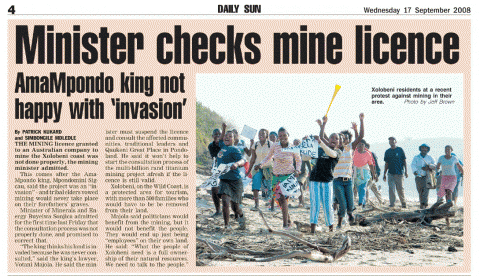
Notice to this effect surfaced when Minerals and Energy Minister Buyelwa Sonjica admitted for the first time last week that the consultation process into the planned multi-billion rand project was “flawed”.

Her comments follow a heated meeting at Xolobeni, where AmaMpondo King Mpondomini Sigcau, through his lawyer, demanded that the mining licence be withdrawn and that a proper investigation into the project be conducted.

The regent made it clear that tourism is preferred over mining, prompting Sonjica to concede that “no proper procedures were taken”.

“Now I know things I did not know; something is not right, and I have to correct it,” she said.

"This type of civil action is a very interesting test for our democracy. It is overwhelmingly clear that the local community object to the mining and that other citizens of our country, when informed of the facts, also vehemently disagree with a process that is blatant in its purpose of minority enrichment. If the public voice, the voters voice, fail to stop immoral activity such as the mining of the Xolobeni beaches, then we are a democracy and society deeply in trouble." -Will vd Merwe

That was the comment by the 4,190'th person to sign the Online Petition against strip-mining for titanium at Xolobeni: www.petitiononline.com/xolobeni/petition-sign.html

Throughout the day, whenever I checked, the signatures seemed to be coming in at a rate of about 100 per hour. Though now, at about 6pm on a Friday evening here in SA, and surprising as it may seem, they've slowed to a trickle. Be great if it maintains momentum next week.

Click on the pic to view the article.

I came across this link on the OLPC wiki. It's a really cool Java applet that illustrates from the edge of the universe to the surface of a proton. Check it out: http://micro.magnet.fsu.edu/primer/java/scienceopticsu/powersof10/

Click on these amazing photos to go to the Florida State Uni's Micro Magnet website.

Personally I think the ampicillin photo is the most awesome 3 dimensional abstract art I've ever seen. Look closely. It's like looking through a stereograph.

"South African Finance Minister Trevor Manuel welcomed the project when speaking at a conference in Germany.

"The information gap is very real and clearly whatever we can do to close it must be encouraged," Manuel told a news conference in Berlin on the U.N.-backed Millennium development goals.

"Any initiative that can leapfrog over traditional means of getting information to people must be encouraged. Information is power and it supports democracy and it supports decision-making.""

Hahaha. About time too. I wonder if Ivy knows...

From: http://www.moneyweb.co.za/mw/view/mw/en/page39?oid=224027&sn=Detail

Kate Holton and Niclas Mika
09 September 2008 16:18
LONDON/AMSTERDAM -

(Reuters) - Internet firm Google and Europe's biggest bank HSBC have thrown their weight behind a plan to provide cheap, high-speed web access via satellite to millions in Africa and other emerging markets.

We finally have budget approval and are back on the system!

Initially, our project implementation was delayed by about a year, and the boss (Dr Gugu Calvo-Ugarteburu) submitted a revised MoA, extending the period of the contract by a commensurate year; which was accepted by the department and printed and sent through for signing by the university administration in about June 2007. Unfortunately at the time that it was issued for signature by both parties, the political situation at Hole in the Wall deteriorated to such an extent that the headwoman cancelled the project as at the 1st June 2007.... and the WSU (Walter Sisulu University) administration staff could not sign the revised MoA because of the subsequent changes in the deliverables.

NESTLED between the rocks near Coffee Bay that were once stripped bare by beachcombers, signs of life for the Wild Coast’s most prized delicacy – mussels – are slowly starting to return.

For eight years community members and managers have worked hand-in- hand as part of a project to re-establish mussels on the rocks.

Today, Coffee Bay’s mussel rehabilitation project feeds some 60 families and teaches the community the value of a scheme in which care for the environment reaps its own rewards in the form of a valuable protein source.

“A study done by Walter Sisulu University showed that many children in this area depend on mussels for at least 30 percent of their protein intake per day,” said project manager Jeff Brown. At one of the sites at Nqutheni, some 2km south of Coffee Bay, waves crash over well-established mussel beds.

Val Payn

Although the Wild Coast mining controversy is often depicted primarily as an environmental issue, this portrayal misses core elements of the debate. Yes, there are many grave environmental concerns about the venture. But at its heart the dispute is about land use.

It is about who holds power over the land, and who has the right to determine what happens on that land. It is about what type of land use will be most advantageous to poor communities who live on the land. It is about the right of rural communities to self determination. It is about the rights of land occupants to be part of decision making processes that impact upon their livelihoods. It is also about what political and economic processes would best serve the interests and needs of rural communities for posterity?

Click on the image for higher resolution.

Download the Inkscape .svg file here: www.wildcoast.com/files/xs.svg

When I arrived here in 2006, about the first thing I did was put in applications for the school at Hole in the Wall to become a TuXlab. I have been in the IT industry since 1988 and have a huge amount of experience on everything from routers to servers to financial systems to web and graphic design; but Linux and networking are my forte, and helping the schools seemed like a perfect thing to do with all that expertise. I phoned and emailed and hoped and waited, but after 6 months of that eventually realized I was making zero headway with TuXlabs, and I asked my friend Ant Brookes to please put me in touch with anyone who could help. Ant put me in touch with Bernie Amler, Director of Social Responsibility at Uniforum; and my first call to Bernie lasted about an hour (cell phone rates = ouch!) and was most interesting indeed. Especially as Bernie didn't just want to do one at a time, but as many schools in the region as had power and available space.

Some have been arguing from the outset that the valuation of $18 million which Xolco have to pay for their 26% stake (minimum BEE criteria) was baseless, and proved that no negotiation took place with truly affected parties; as they obviously never took negotiable access rights and royalties into account.

Yet Ehlobo Heavy Minerals, the original BEE partners who walked away from the deal because of environmental issues and other implications, were only going to pay a third of that price for their majority stake.

Read TFA from Business Report:

Questions hover over Wild Coast mining deal
August 14, 2008

By INGI SALGADO

There are perplexing questions around last week's granting of mining rights in a 7km stretch of pristine coastline at Xolobeni, part of the Wild Coast that would be most inaccurately named were heavy metal extraction to proceed.

A few reasons why the mining should not be allowed to proceed:

1. The strip mining method which is planned to be used is Dry Mining. This will entail a huge dust fallout which will affect all residents in the area (plant, animal and human... and especially the breeding river estuarines). Furthermore the Wet Separation Plant (WSP) which is then used to separate the Heavy Mineral Concentrate (HMC) requires 2 MILLION liters of water per hour, 24 hours a day... which will affect the water table of this fragile biosphere HUGELY.

"The state of our environment is fragile and needs every citizen’s involvement to protect it. Our Constitution is one of the few in the world that gives its people the right to a clean and healthy environment.

At my inauguration, I stressed the link between our soil and a personal sense of renewal. Our soil, along with all our natural resources, is a precious asset that we cannot squander.

Our people are bound up with the future of the land. Our national renewal depends upon the way we treat our land, our water, our sources of energy, and the air we breathe.

The end of apartheid closed a shabby and divisive chapter in the history of our country. As we go into the future together, we need to be united in building a sustainable basis for the use of our resources.

50/50 will be broadcasting a report on the Beach Protest March/Walk, and the story of ‘Scorpion’ Dimane - one of the leaders of the Crisis Committee, - (who unfortunately wasn’t able to be there), tonight Monday 11 August at 7.30pm on SABC TV 2. It includes damning footage shot last year when the EIA process commenced, testifying to allegations of bribery... and worse... to force the local residents to support the mining scheme.

Apparently DME have agreed to join a studio debate on the matter, to be filmed on Wednesday next week, and broadcast the following week.

Skulduggery and dune mining
(From Noseweek)
by Erika Schutze

Residents in the Xolobeni district in Pondoland find themselves the victims of the manipulative tactics of an Australian mining company on the hunt for titanium deposits, the tunnel vision of the Department of Minerals and Energy, as well as a couple of scheming ANC bigwigs (ex of the Department of Trade and Industry) intent on becoming the BEE beneficiaries of the proposed mining deal -- without ever having consulted those to whom the land belongs.

Moreover, the BEE deal that has been set up effectively lands the local tribal shareholders in massive debt for the 26 percentage of shares that they do get: they may only earn dividends after their shares have been paid off, projected to take at least three years if revenues match expectation.

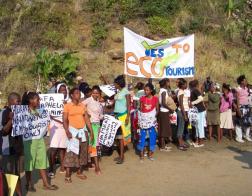
Hundreds of people walked from Wild Coast Sun to meet the people of Xolobeni.

Despite the pro-mining lobby tricking many members into not attending (by announcing a food-basket handout for the same day) it is apparent that the community, as represented by hundreds of people present, sangomas and the headman, are totally opposed to the strip mining of 22km of their pristine grassland and dunes.

In fact they have threatened to revolt, like the Pondo Uprising of 1960, if the government grants the mining license.

These pictures do very little to convey the beauty and incredible historic / archeological value of this portion of the irreplaceable Pondoland Center of Endemism.

Benny the Tour Guide can be contacted on 079-1985 975 / or through Sonya on 074-336 7862 - for a guided day-trip.

See for yourself why we must protect our children's ecological heritage.

There are many things in this world that are beyond my understanding or capacity to articulate clearly. I feel not only inadequate, but also threatened by the situation surrounding me at Hole in the Wall, or rather, I truly fear taking a public stand. I don't have the clarity or writing capability to do the story true justice:

Sometime in 2003 the headman, Mzoxolo Ngubenani, was shot and killed while in Rustenburg. According to local sources, his estranged wife, Nowinase, had left him about 15 years prior to his death and she had been living with another man in Johannesburg. Shortly after Mzoxolo's murder she returned to the region with a son of approximately 9 years of age whom she claimed was his legitimate heir, and she was then installed as regent / headman by the king of the abaThembu, Buyelekhaya Dalindyebo.

Jeff Moloi wrote a short article which was published in the Enroute newspaper. My response, which I also posted to Jeff's facebook group, precedes the verbatim quote of his article:

Can the Transkei afford to keep the Wild Coast “wild”?

Just last week there was the 3rd meeting in terms of the SDF (Spatial Development Framework) for the Kwa Tshezi Development Association. (The Tshezi district is basically from Umtata Mouth down to Hole in the Wall, under Chief Ngwenyathi [Ward 23 under clr Mvunge]).

Ideas are being discussed for the controlled development and economic upliftment of the area; but it is a very slow process involving long term logistical planning for gradual urbanisation. Things like solid waste disposal and water borne sewerage systems . . . and allowances for environmental corridors, and even graveyards, seem to take up an inordinate amount of time... But fortunately the one huge factor inhibiting all development on the Wild Coast is also slowly being addressed for the area: namely, Land Tenure.

As a permanent resident of Hole in the Wall (and owner and webmaster of www.wildcoast.com) I have very mixed feelings about commercializing the pristine hills and coastline where I grew up; but also see it as inevitable.

In fact there can be a happy balance between civilization and nature, as I've witnessed on the Cornish coast in the UK: Tintagel, which legend has it was the location of King Arthur's seaside castle, is strikingly similar to the cliffs and rolling green hills of this central region of the Transkei coastline... and has a magical vibe of it's own (the rocks in the bay are green marble)... yet tar roads neatly link up the village's shops and homes, and overall it is far more pleasant driving around there than it is here on the Wild Coast. And it is fantastic to pop into a bakery or a pub for a classic Cornish pasty and a mug of [whatever].

What we need to watch out for is developers with $ eyes and backhands to greedy officials to allocate large tracts of land for luxurious or simply impractical macro-economic developments.

The first world was developed by free enterprise and entrepreneurial spirits. It would be so wonderful if the land tenure was addressed urgently so local citizens could develop and open: B&Bs, restaurants, backpackers, craft stalls, coffee shops (and yes, the Amsterdam-style coffee shops would be an amazing tourism attraction - but our so-called liberal government is not enlightened about the weed o' wisdom at all).

The 1993 coastal decree and moratorium on development within 1km of the coastline has held us all in paralysis for far too long... and is as damaging to the economic welfare of the people as it has been beneficial to the environment.

People are part of the environment too. Natural organisms with natural needs and social requirements.

We don't want large scale developments which indenture a few locals into wage-slave existence; but rather a framework for allowing small scale natural development.

Naspers owned Media24 is attempting to create a local portal in competition with Google.

There isn't really enough room for another new search engine operator and pesky web crawler, plus if ever there was a company that needed re-branding - Naspers could compete for top of the all-time list.

The Afrikaans publishing house with Broederbond roots has grown into Africa’s most successful media conglomerate. A few years ago Ton Vosloo, the chairman of Naspers was considered a mouthpiece for the conservative Afrikaner establishment that conceived, legislated and maintained apartheid. Vosloo was a member of the Broederbond; the secret society of lawyers, judges, parliamentarians, cabinet ministers and business and political leaders who ran the government and sought to empower the White Afrikaner population.

http://ntww1.csir.co.za/plsql/ptl0002/PTL0002_PGE157_MEDIA_REL?MEDIA_REL...

Researchers at the Meraka Institute have released an Open Source spelling game which supports all 11 official South African languages.

I'm hoping it may just turn out to be useful for computer classes at the 5 schools around here.

It's about a 40meg download, and is also available for Windows.

Download it here: http://www.brainhotel.org/openspell