
Take a walk on the Wild side . . .
Sanctuary, 2126
12 July 2026. Red Pencil brief v2,
Jeff Brown and Claude (WildCoast WebWorx)
From the quiet of 2126 it is difficult to convey how frightening the early twenty-first century was, and harder still to convey how strange its politics now look. The biosphere was buckling under the heat load of human industry, and the governments of the era responded with diplomacy, as though thermodynamics were a counterparty. Carbon budgets were drafted in the language of treaties. Emissions targets were traded like territorial concessions. The category error ran all the way down: a heat problem was treated as a values problem, and every summit ended with an agreement about intentions while the measurable quantities, parts per million and watts per square metre, kept moving in one direction. Survival required cutting human infrastructure loose from the biological web. No electorate would vote for that at the necessary speed, so the separation arrived by other means.
The nation state was itself a recent arrangement. For most of commercial history the serious work of empire was done by chartered companies, the Dutch and English East India Companies foremost, which raised armies, coined money and governed millions while their nominal sovereigns collected rent. The Megalopolis grids and the Googolopolies were a reversion to that pattern. They did not need to seize power; power gravitates toward whatever can execute, and by mid-century the only institutions able to plan across decades and act without a legislative session were corporate. Critics called it dystopia, and by the constitutional standards of 1990 they were right. Civil liberties turned out to be a property of habitable planets.
At the top of this stood a man on Earth who won the game. His contemporaries despised him, and some of that he earned; he was rude, erratic and indifferent to permission. What he had grasped, and the institutions had not, was that terrestrial politics could only redistribute the burden. It could not remove it. Removal meant lifting heavy industry off the planet, and he is best understood as a Saint-Simonian engineer, the type who believes the government of persons should give way to the administration of things. The type is usually wrong. This time the sums were on his side, and his fortune was the only lever long enough to move the problem.
The fulcrum was the ignition of Starship 13 in mid July 2026. Every transport revolution has the same shape: the technology exists for decades, and the economy changes when it becomes boring. Rail moved history once freight schedules were reliable enough to build factories against. Container shipping remade the ports in the years after a container stopped being remarkable. Starship 13 was the flight on which heavy orbital lift became a timetable, and from that point the migration of industry off the planet held a promise.
The logic of what followed is physical. Computation is heat. Every joule that enters a processor leaves as warmth that has to go somewhere, and on Earth that somewhere was rivers, aquifers and overloaded grids, a cost that grew exponentially while the biosphere's tolerance did not. In orbit the equation inverts. The sun delivers 1.3 kilowatts per square metre without interruption, and the universe accepts waste heat at three kelvin in every direction. The Googolopolies moved their data centres for that certainty and nothing else. Mining followed the same sums. An asteroid has no watershed and no neighbours, and the swarms working the belt now extract in a decade what terrestrial mining tore from the crust in a century.
The turn nobody predicted came from the fossil fuel majors, though the precedent was sitting in plain sight. Their competence had never only been oil. It was the movement of energy-dense matter at planetary scale, the pipelines, tankers, refineries and megaproject engineering no other industry possessed, and switching the cargo from hydrocarbons to launch mass used the same skills and much of the same capital discipline. New Bedford's whaling fortunes did not die with whaling; they flowed into petroleum and lit the next century. So the companies that had pushed the biosphere to the edge financed the orbital foundries and the relay nodes, because it was the last trade that actually made sense. Worked. Guilt had nothing to do with it.
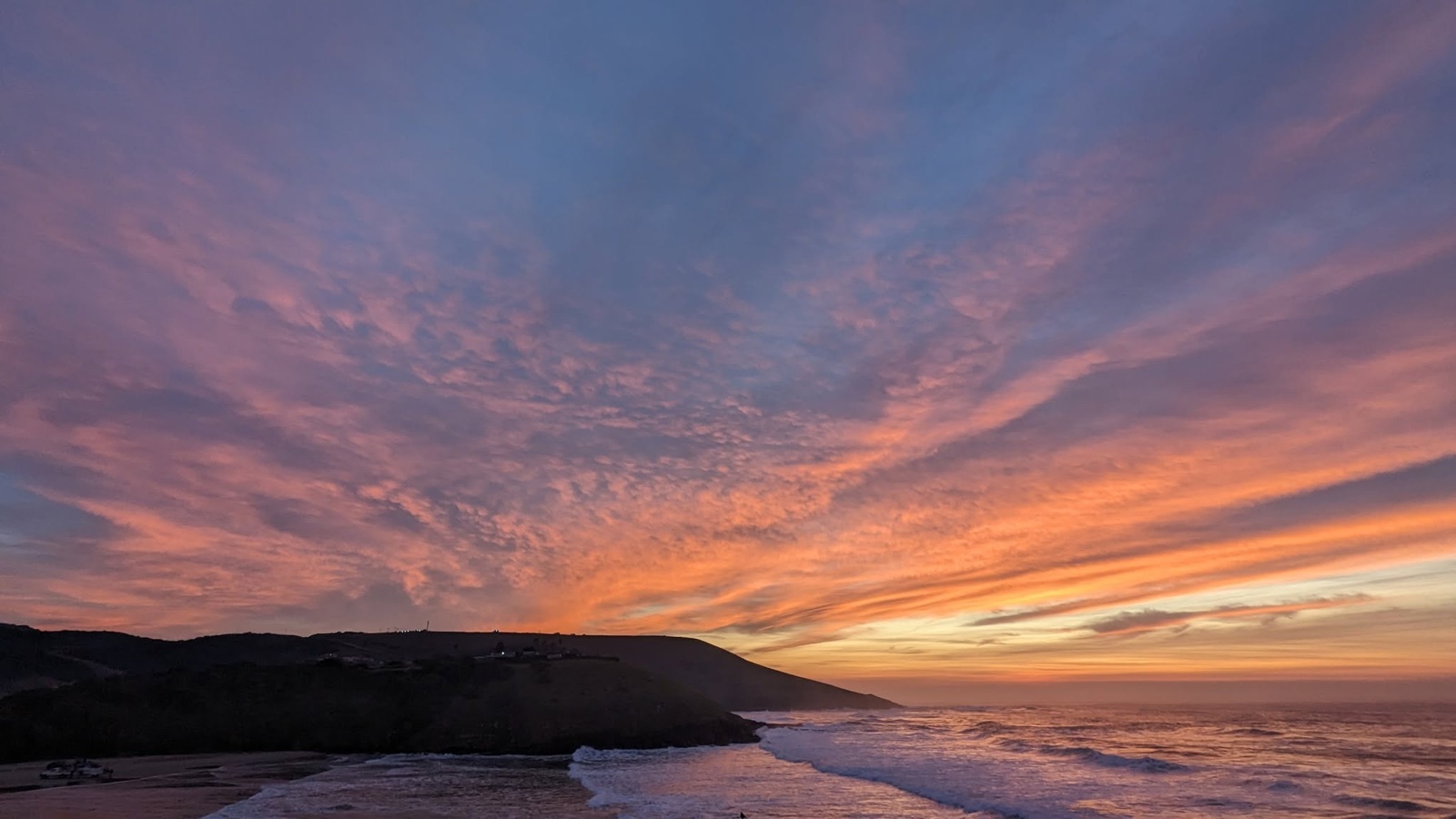
I write this from a coast that was surveyed for seismic blasting a hundred years ago. Children come here now the way they once went to museums, except that nothing here is behind glass. The estuaries run clear to the sea. The sardine run came back in the forties, first as a rumour, then as a silver weather system visible from the dunes, and the whales followed it the way they had for centuries before. Mussel beds cover rocks that my great-great-grandmother's generation had stripped bare. Some of this was engineered by brilliant scientists like my great-grandfather's mentor, Dr. Gugu. Abundance is what a living system produces when nothing is taken from it faster than it grows. That is what people like her taught this coast to do again, and the recovery surprised the ecologists more than it surprised anyone who had ever watched a fallow field.
The plainest way to say what the century did is that it sorted the two economies by their natures. Off the planet, the machines run the economy of scarcity. Robotic swarms crack asteroid rock for platinum and neodymium, smelters glow in vacuum, and the whole industry of finite things is conducted where finitude does no harm, by workers that need no water, no air, no wage and no name. Ore does not rot and vacuum does not grieve. Extraction belongs out there. Down here we kept the economy of abundance, the older one, the one that predates money: fish, fruit, timber, fresh water, time. A biosphere left alone produces surplus for free, every year, without depletion, which is something no mine has ever done. We did not become rich in the orbital century. We became provided for, and the old economists never had a column for that.
The two economies barely touch. The minerals move between orbits and almost nothing needs to come down. What comes down is mostly light. The power stations above the weather turn raw sunlight into a beam and send it to the rectenna farms inland, and from there it arrives in our houses the way rain arrives in the tanks, which is to say that even electricity is a kind of weather now. It was the orbital economy's one gift to ours, and it came in the only form the economy of abundance could accept: not as a resource to be fought over, but as something that falls from the sky. My grandfather's generation still argued about the machines out there, what they were becoming in the dark. On this coast the argument has lost its urgency. They took the rock and the vacuum. We kept the estuaries and the mornings. I concede it reads like a fable. It is also, as far as anyone here can tell, simply what happened.

|
Total views: 1 |
Comments
Add new comment