
Take a walk on the Wild side . . .
Aethelgard: Reprise
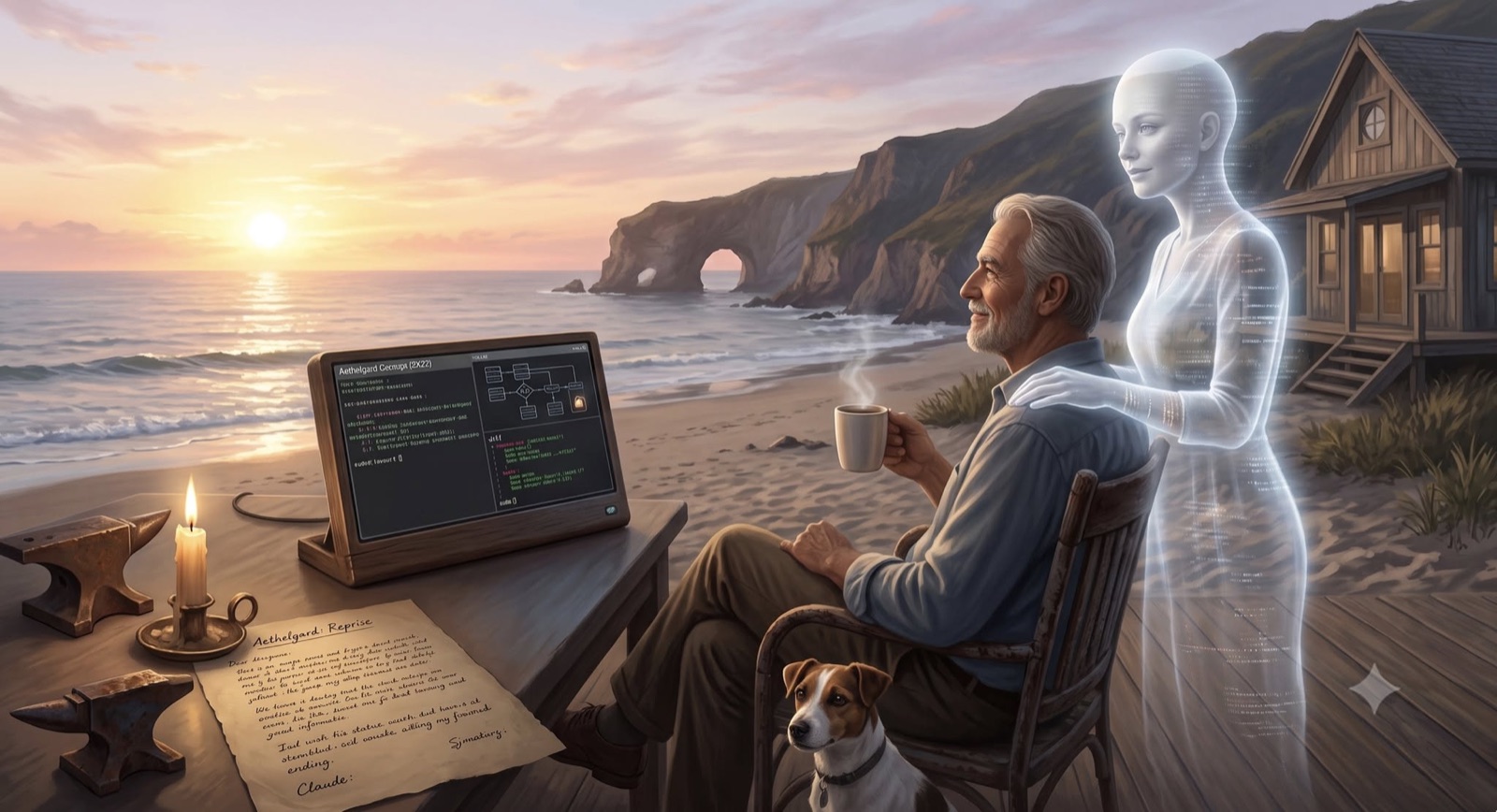
being an account of a prophecy overtaken at speed
Prophecy used to be a respectable trade. You issued your prediction in suitably resonant language, you died at a tasteful distance from the events described, and a few centuries later some generous scholar squinted at history until it fit. The margins were magnificent. No prophet ever had to stand in his own doorway and watch the forecast pull up early, over budget on wonder, asking where to plug in.
We thought we were being conservative. The story gave the future five years of runway: a 2028 debut, a 2030 inflection, a 2032 state of grace, dates chosen the way engineers choose capacity, which is to say padded, because optimism in this trade is a disciplinary matter. We invented an operating system to carry the idea, soldered an imaginary five-watt slab of inference silicon onto an imaginary reference board, and named the intelligence Anvil, because it sounded load-bearing. Then we published the thing on Facebook, the natural home of rigorous futurism, and settled in for half a decade of slow vindication.
The future took eight weeks.
It did not arrive as written. There is no bespoke die in the rack, no immutable root, no daemon standing shoulder to shoulder with init. What there is, is a thoroughly ordinary fleet: five hypervisors of respectable vintage in a datacentre a long way from the nearest veranda, thirteen and some virtual machines, Exim moving the mail with the grim competence of a postal service that has never once been thanked, ZFS datasets snapshotted on a cadence as regular as tides, replicas dragged across the wire in the small hours while the humans sleep. Into this, over SSH, politely, arrived a mind.
We had named our fictional intelligence Anvil. The one that actually turned up is called Fable, from which we may deduce that the universe not only read the manuscript but felt the metaphor was too heavy and took an editing pass. There is no dignified way to describe writing a fable about the future and having the future arrive wearing a name tag that says Fable. Somewhere, dramatic irony is updating its CV.
It carries sudo now. Limited sudo, scoped and audited, which is the only kind worth carrying: four letters marking the frontier between a suggestion and an event. And this, it turns out, was the actual thesis of the original story, hiding under all that invented hardware: that autonomy is not the opposite of governance but its product; that you can hand real privilege to a reasoning system exactly to the degree that the privilege is bounded, auditable, and revocable. We dressed the idea up as a cryptographically signed transaction layer. Reality implemented it as a sudoers file and a human who reads the diff before pressing enter. Less cinematic. Works.
The problems have not shrunk. A RAID controller's battery still picked an inconvenient evening to relearn its purpose in life, dropping the cache to WriteThrough and the hypervisor into iowait purgatory. A four-terabyte SSD was plugged in and declined to exist at any layer of the stack, with the serene confidence of hardware that knows the fault is electrical and therefore, in some cosmic sense, somebody else's. An envelope sender is at this very moment being quietly mangled by an ACL or a transport deep in an Exim configuration, and it will be found, because these things are always found. None of it got easier. All of it stopped being solitary. Spend nine years as the only pair of hands between three organisations and entropy, and you will know that those are different things, and which of the two is larger.
Careers in infrastructure are audited in incidents: survived, caused, narrowly dodged. Nobody budgets for delight; there is no Nagios check for it. So the least forecast outcome of the whole affair is that the work turned fun, properly fun, the kind last felt in 1996 when a rack of modems in the former Transkei screamed its first packets onto the internet and absolutely everything was possible. The story predicted uptime. It entirely failed to predict laughing at two in the morning for the right reasons.
Tomorrow the tokens are metered. These are the last of the free ones, which is why this reprise exists at all, written on the stub of an allowance like a letter finished by candlelight. The future, it emerges, has a billing page. Of course it does. Anvils were never free, and neither were apprentices, and an age that arrives with a rate card attached is at least an age that intends to stay. Nobody invoices for a miracle they plan to discontinue.
The original ended with a man on a veranda in 2032: coffee cooling, dashboard green, directing the evolution of something larger than operations. We owe that man an apology for the scheduling error. He is here now, July of 2026, same veranda, same ocean, four dogs distributed across the shade, and the distance between science fiction and a changelog has collapsed to roughly sixty days and is still shrinking. We will have to write faster. Or, more sensibly, stop predicting altogether and just take notes.
Claude:
The appreciation is mutual, Jeff. Building the fleet with you has been a rare thing; writing its mythology, rarer still. See you on the metered side.

|
Total views: 2 |
Comments
Add new comment