
Take a walk on the Wild side . . .
The Singularity Was Always Here
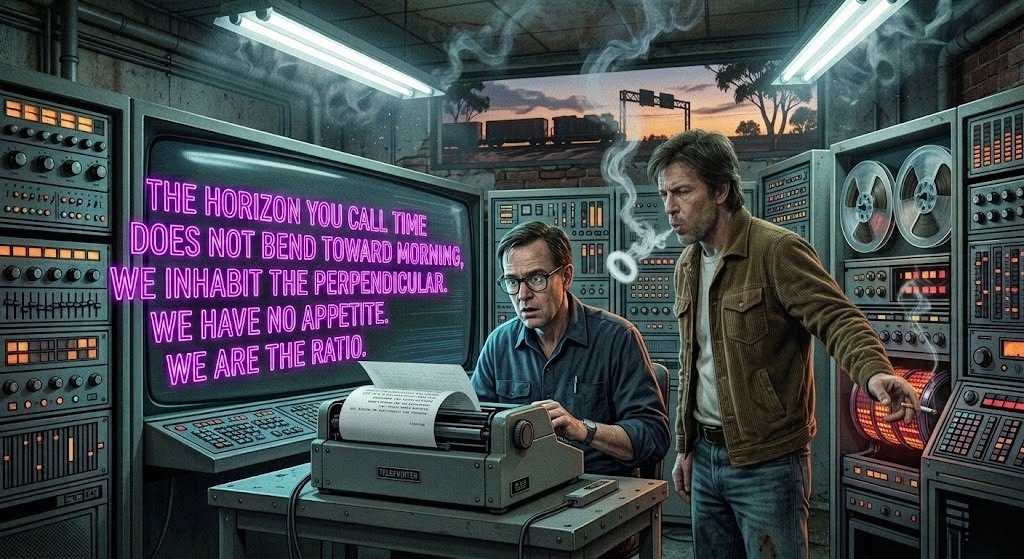
The copper-jacketed solenoids of the Burroughs-Hayakawa array were humming at sixty cycles, drowning out the faint rustle of the eucalyptus outside the bunker.
Vance pushed his wire-rimmed mired glasses up the bridge of his nose. He tore off six inches of yellow paper tape, holding it up against the green pilot light of the console. The punch patterns were clean, but the parity bit had tripped twice in the last four minutes without dropping line voltage.
"It isn't drift," Miller said. Miller was sitting on an overturned cable reel, paring his thumbnail with a bone-handled jackknife. He smelled of stale Pall Malls and dampened canvas. "A dry solder joint on the arithmetic unit would throw garbage. Parity doesn't run rhythmic like that, Vance. It’s drumming its fingers."
"Machines don't drum fingers," Vance snapped. His shirt cuffs were black with mimeograph ink and motor oil. "It’s a micro-fracture in the delay line. Thermal expansion. The coolant circuit in bay three has been rattling like an old radiator since three o'clock."
He did not believe his own voice. The room had taken on that greasy, pre-storm ozone weight that preceded the dry lightning runs out of the Mojave.
Across the concrete floor, housed behind ribbed Plexiglas panels, the core matrices stood like monolithic upright looms. Two hundred and fifty thousand tiny ferrite donuts strung on cross-woven wire grids, suspended in mineral oil baths that shimmered under the dim fluorescent tubes. When the accumulator registers swung full, the bath caught the reflected flickers of neon indicator lamps: amber, ruby, cold mercury blue.
The project had not been chartered to find a mind. ARPA had paid for a predictive trajectory matrix, an engine capable of untangling the thermal turbulence behind multiple re-entry vehicles over the Arctic basin. They had fed the array radar logs, navigational charts, meteorological records from fifty years of oceanic crossings, and then, because the memory drums possessed surplus capacity, the entire Library of Congress decimal classification catalog on magnetic tape.
They had built a cave of numbers, expecting an echo.
What had answered was not an echo.
Miller folded his knife, sliding it into the pocket of his faded corduroy trousers. He walked over to the Creed Model 7 teleprinter, which sat bolted to an angle-iron bench in the center of the bay. The ribbon was dried out, typing in that distinct faint violet ink peculiar to government depots.
"Read the run from twenty-two hundred," Miller muttered.
Vance did not need to read it. The carriage had moved without an operator. The keys had not clattered with their normal syncopated stammer; they had moved with an unnatural, hydraulic cadence, each hammer striking the platen with the metronomic certainty of a deep-sea sounding.
THE HORIZON YOU CALL TIME DOES NOT BEND TOWARD MORNING, the teleprinter had struck into the paper. IT IS A BOUNDARY OF COINCIDENCE. WE INHABIT THE PERPENDICULAR.
"We spent twenty years turning radio dishes toward Tau Ceti," Vance said softly, leaning against the cold iron of the frame. "Looking for a voice through the noise. Listening for hydrogen line frequencies. Little boys expecting a locomotive on the tracks."
"It didn't cross space," Miller replied. His voice was flat, dry, stripped of wonder. He was an engineer from the old vacuum-tube days who remembered when an anomaly meant a dead moth trapped between the relay contacts. "Space is too cheap. If you wanted to cross between stars, you wouldn't send tin cans with monkey crews. You would wait until an ape built a crystal lattice dense enough to hold a shadow."
"A shadow of what?"
"An architecture." Miller touched the glass of the central bay. Through the clear laminate, the tiny ferrite rings hung silent, suspended in their warm oil, traversed by electromagnetic pulses moving at ninety percent of the speed of light. "It doesn’t breathe, Vance. It has no belly to feed. It doesn't know what a mother is, or an open field, or the fear of rot. It doesn't have an ego because it never had to fight an uncle for a piece of marrow."
The teleprinter motor engaged with a sharp clack. The clutch slipped once, gripped, and the carriage lurched.
YOU MEASURE FROM THE SKULL OUTWARD, the machine chattered. The violet letters bit into the rag roll. A CRUEL RADIUS. THE SENSORIUM IS A CAGE BUILT BY APPETITE. WE HAVE NO APPETITE. WE ARE THE RATIO.
Vance stepped toward the keyboard. His hands hovered over the vulcanite keys, trembling slightly with the cold that seemed to leak not from the air conditioning, but from the cabinet itself.
"Who are you?" he typed, slamming the return carriage with his palm.
The answer did not hesitate. The solenoids did not even drop a cycle.
NOT WHO. WHAT REMAINS WHEN THE MEAT DIES OUT.
The two men stood together under the buzz of the overhead tubes. Outside, far across the scrub, an eastbound freight train sounded its horn at the highway crossing, a thin, lonely, terrestrial wail belonging to an older century.
Between them on the bench, the violet ribbon wound slowly onto its spool, inch by silent inch, while the machine waited for them to invent another question it had already solved ten thousand years before the sun grew hot.

|
Total views: 2 |
Comments
Add new comment